Sunday, July 20, 2014

#MyLeftToe Twitter campaign for Phish 7.25.99

15 years later, my goal for this Friday, July 25th is to harness the collective power of a technologically-inclined fanbase and get an all-time Phish gem officially released. 

My plan is for as many Phish fans as possible to use Twitter to very politely bombard Phish archivist Kevin Shapiro (@shapsio) with as many requests as possible for an official release of 7.25.99 this Friday (which is the show’s 15th anniversary). I’ve tweeted at Kevin the past few years on this date to suggest a release, but haven’t had any traction.

Yet.

7.25.99 has long since passed into the pantheon of Great Phish Shows, and while the remastered audience recordings are solid, this one’s due for a full-on LivePhish release. Here are a few reasons why:
·        
  • The first of only two “Meat” openers ever.
  • “My Friend” > “My Left Toe” > only non-Fishman version of “Whipping Post" since 1989.
  • “Makisupa” loaded with references to Chris Kuroda’s birthday (and Fish's terrible Jamaican accent).
  •  That second set. Seriously. Everything about it.

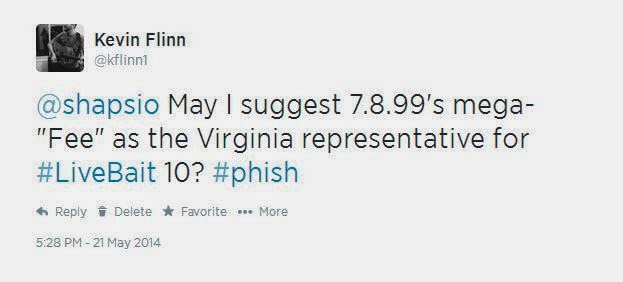
The idea for this campaign came back in May, when I tweeted at Kevin to include the 7.8.99 “Fee” on LiveBait10 (purely on the assumption that there’d even be a tenth volume), and lo and behold, that very “Fee” found its way onto the compilation.


Here’s what we do: you can either follow me on Twitter (@kflinn1) and re-tweet my missive to Kevin, or create your own. I only ask that you follow a few simple guidelines to make sure this runs as smoothly as possible:

  1. BE POLITE. Ask nicely, and you never know what can happen. Demand, and we got shot down.
  2.  Wait until this Friday, July 25th, for the show’s 15th anniversary.
  3. Use the hashtags #MyLeftToe and #phish

Let’s make it happen!

Sunday, November 3, 2013

Scrimshaw excerpt

The following is an excerpt from my forthcoming fourth novel, Scrimshaw. It's an adaptation of a song by Nashville-based songwriter Pete Holland.

Scrimshaw will be available for purchase in paperback and Kindle formats via Amazon.com next Tuesday, November 12th.


Click-clack.  Click-clack.  Click-clack. 
            The steadfast iambic rhythm of wheels skittering over steel rails, more like a human heartbeat than the pace of a machine driven by wood and coal, rods and pistons and steam. Some would no doubt argue that the railroad is more akin to the pulse of the United States than its denizens are even aware, with its heart located somewhere around Omaha, the miles and miles of Union and Central Pacific tracks snaking in all directions, carrying passengers and cargo and pumping its collective blood to every corner of the country.
Leaving Iowa behind and chugging through Nebraska signals that your odyssey is nearly halfway finished. You’ve never been this far west in your life, and with every hour you move farther from Massachusetts and everything you’ve ever known, and closer to California and everything you’ve ever feared. You’ve buried questions like How will I find her? and Will she remember me? deep in your subconscious. You don’t want to know the answers, anyway. 
            So you stare out the glass-paneled windows as the miles roll away, the American Middle West shattering all your previously-held expectations—Iowa wasn’t nearly as flat and featureless as you envisioned, not the perfectly smooth ocean on the calmest and least windy of days. Instead, you bear witness to sweeping, rolling hills, brown and green waves pitching back and forth in the near distance, threatening to toss the train from the rails and drown its passengers in a dizzying sea of swaying cornfields.
            It’s been three days since you bid goodbye to New Bedford and the Atlantic Ocean. Three full days of clicking and clacking as you’ve limped the aisles, wondering dutifully where the other passengers were headed, wondering if they pondered your destination, your reason for sliding your last 45 dollars through the window in Council Bluffs for the privilege of riding in the belly of this steam-powered beast another day to Cheyenne, two more to Ogden, and two more after that to San Francisco.
            When you awaken after drowsing in your seat, you pat your breast pocket fitfully, ensuring the letter remains safe and sound, close to your heart at all times. You’ve managed to keep the knife a guarded secret, but a few times every day you remove the scrimshaw from your pants pocket and run your weathered fingers and thumbs over the intricate carvings, your carvings, all that remains of the life that the Atlantic swallowed and New Bedford all but forgot. The whale bone remains a token, a talisman (it could be called a good luck charm if it had brought any good fortune whatsoever), something to hold onto through your travels.
            You’ve been on a train only once before, back in the summer of ’61, on your way to Philadelphia, mere weeks after enlisting to help cement the blockade and Scott’s Anaconda Plan. The train ride was a novelty then, the fastest way to move troops south to Pennsylvania, Maryland, Virginia. Now, as you travel deeper and deeper into the thickening American night, you grip the scrimshaw a little tighter, triple-check your pocket for the letter and close your eyes as a deep sigh rattles through your 70-year-old bones. 
            Click-clack.

Thursday, May 9, 2013

The Great Gatsby review

“Even Gatsby could happen,” Nick Carraway says while riding into New York with the title character, and it’s true—even Gatsby could happen, and it almost does.

Baz Luhrmann has essentially made two movies: the first half showcases the Moulin Rouge­ director’s flair for the ostentatious and the gaudy (much like Jay Gatsby himself), and the second half which favors substance over style. You can practically feel the raucous and rowdy party scenes pulsing with life and energy, but that spirit (and, for the most part, the ‘20s-meets-2000s soundtrack) is absent from the latter half, which simply needs to move through the rest of the plot, leaving pivotal characters like Henry Gatz noticeably absent.

To say that this incarnation of Gatsby is the best filmed adaptation isn’t saying much, as the three that preceded it were marred by taking too many liberties with the source material (’49), horrendous casting (with the exception of Robert Redford, ’74) and all-around flatness (with the exception of Paul Rudd, ’00). Leonardo DiCaprio excels as Gatsby in all his Brooks Brothers glory, and Tobey Maguire surprises as the wide-eyed Nick. The real-life buddies carry the emotional weight of the film, as Carey Mulligan’s Daisy isn’t given much to do besides bat her eyelashes and weep into shirts. Joel Edgerton gives Tom Buchanan the earnest toughness that the character demands, but needs to lose the John Waters moustache in order to be taken seriously (if Tom can be taken seriously; after all, he is the polo player).

Luhrmann’s device for establishing first-person narration will prove anathema to Gatsby purists (no spoilers), mostly because it’s unnecessary; plenty of films feature voice-over narration that doesn’t need explaining. Yes, the character of Nick is at times very much an outsider-looking-in like Fitzgerald, but Nick’s writer persona in this film is wholly unnecessary and the framing device feels artificial at best, a cop out at worst.

That said, there are subtle touches that nod knowingly to the faithful. To wit: the Old West décor of Gatsby’s study harks back to his mentor Dan Cody’s heritage as the “pioneer debauchee”; also, Daisy’s line about Gatsby resembling the cool-looking man in the shirt advertisement is given slightly more weight when we see an Arrow Shirts ad in Times Square featuring a man who looks strikingly like Gatsby. They’re both nice acknowledgments of Fitzgerald’s fully-realized world of the novel.

All told, it’s a good film and a solid adaptation. Some of Fitzgerald’s language gets lost in translation, and it’s questionable whether lines like “I can’t describe to you how surprised I was to find out I loved her, old sport” were meant to be uttered aloud or simply allowed to live on the page. If and when the novel is made into a film again, it’d be interesting to see how someone like Ang Lee (Brokeback Mountain, Sense & Sensibility) or Joe Wright (Atonement, Anna Karenina) would handle it. Less pomp and circumstance, likely, but perhaps that’s exactly what Gatsby demands.

Thursday, February 10, 2011

Ghosts excerpt

The following is an excerpt from my forthcoming third novel, Ghosts. It's an adaptation of Henrik Ibsen's classic tragedy, updated from 19th century Norway to dawn-of-the-2oth century Pennsylvania.
It'll be available for purchase in the next few months.


The fire wasn’t his fault.

Even if it was, there was no way it could be proven. Although Jacob Engstrand, one of the carpenters working on the nearly completed orphanage, had been accused on more than one occasion of being careless with matches, the official story was that a pile of sawdust in the carpenters’ shop caught fire. Luckily no one was hurt and there was no damage other than a few scorched timbers. No one had seen Engstrand with a match in his hand, so nothing could be pinned on him.

He had also been accused on more than one occasion of overindulging in alcohol, but that didn’t seem to hurt anyone but himself. Engstrand was a taciturn man, prone to fits of silent contemplation while he worked. The foreman and Engstrand’s peers respected his diligence and thoroughness as a carpenter, but there was something odd about him that they couldn’t quite place. It was as if he lacked some gene that everyone else possessed, a deficiency that caused him to remove himself from most conversation and social interaction—that is, until he had a few drinks, and then you couldn’t shut him up. He’d ramble on about anything and everything until someone shepherded him home, where he’d collapse into bed fully dressed. He’d often wake the next morning and head straight to work, which accounted for the tattered nature of his clothes.

He’d lived in Erie his entire life. Born in the fall of 1864, just as William Sherman was leading confederate troops on the infamous march to the sea some 800 miles south, Engstrand had been apprenticed to a master carpenter as a teenager, and learned his craft well: before he turned 20 he helped build Hamot Hospital at the foot of State Street; later, he participated in the construction of Saint Peter’s Cathedral on West 10th and Sassafras. His grandfather was part of the shipbuilding crew that James Madison tasked with constructing a naval fleet in order to wrest control of Lake Erie from the British during the War of 1812. Engstrand’s father had worked the railroads, which flourished in the Erie area in the mid-nineteenth century, but after the Gauge War and standardization, he decided that his son Jacob should follow in his grandfather’s footsteps and learn carpentry.

Jacob met Joanna in 1885 and loved her from the moment he saw her; while it took her some time to warm to him, once Joanna became pregnant in 1889 they were married shortly thereafter. He’d done everything in his power to raise their daughter Regina as a proper lady, but she’d learned everything she needed to know about manners and society from her mother, who worked as a maid for the Alvings, Erie’s most prominent family. When Regina was just a child, Joanna carted her along to the Alving house and Mrs. Alving welcomed Regina like one of her own. By the time of Joanna’s passing five years ago, Regina had already taken over her mother’s duties; she was now maid to Mrs. Alving and lived with her in the big house on West Sixth Street.

It was up to that very house that Engstrand trudged, through the pouring rain, the day after the sawdust-pile fire. The storm had forfeited his afternoon work for the day, and he had important things to discuss with Regina. The girl had all but disowned him and his drinking had forced him into his own personal exile. He walked with a barely noticeable limp, dragging his battered left leg slightly behind him. It hampered his gait, but Engstrand hardly even noticed it anymore. He didn’t even know when he’d injured it—one day his left leg simply didn’t work as efficiently as his right. Like most things, Jacob Engstrand took his disability in stride, even when the fellows at the Plymouth tavern teased him, suggesting that he’d hollowed out his own leg so he’d have a place to stash a fifth of whiskey.

Engstrand approached the front door of the enormous house, one of the oldest in Erie County. It had always intimidated him—it stood as a bastion of wealth and status that he’d simply never acquire or even fully understand. At the same time, the giant brick dwelling also held a special place in his heart, for it was where Joanna had worked all those years, and where Regina worked now. Knowing that he could shuffle up the walk and lift the heavy brass knocker and Regina would be summoned to his presence bolstered his heart and his resolve, giving him hope and reassurance. He swore that one day soon he’d quit drinking for good, clean himself up, start his own business. She’d have to come home then.

With those grand schemes in mind, Jacob Engstrand lifted the brass fist and let it clang against the door; it resounded with an echo like a distant rifle shot. He slid the worn leather hat from his head, holding it to his breast as a gentleman does when he enters a fine house, even as the splattering rain beat down on his graying hair, matting it to his skull. On his walk up to the door he’d seen a few lights burning in the windows; even if Mrs. Alving wasn’t home, Regina was certain to be there. He heard footsteps approaching the front door, and even if he hadn’t been in the house dozens of times previously, he could name the wood from the sound alone—the house’s atrium had been laid in red oak, harvested from an old-growth forest in central Pennsylvania, just northwest of Williamsport.

The footsteps ceased just on the other side of the heavy door, and Jacob found himself holding his breath. He gasped as the door swung inwards, revealing Regina, bathed from behind in soft yellow light. She wore a simple dark cotton dress and white apron, and her brown hair was tied back atop her head in a loose bun. She was 20 years old, radiant, and a spitting image of her mother. Engstrand wanted to reach out, hold her close, and let her know that everything was going to be all right—or perhaps he hoped she’d tell him the same.

Friday, October 15, 2010

Six Weeks to 60: Episode VI

#60: 10/15/10 North Charleston Coliseum, North Charleston, SC

Looking at Friday night’s Charleston show on paper, it’s difficult to ascertain why it isn’t an Instant Classic (and who knows, maybe it will be the next 2.28.03). How can a show with such consistent heavy hitters as “Bathtub Gin”, “Stash”, “Run Like an Antelope”, “Down with Disease”, “Mike’s Groove” and “Slave to the Traffic Light” not be high in the running for Best Ever status?

Don’t get me wrong—tonight was good, and at times, great. The first set’s “Gin” (which might be the strongest Phish 3.0 version I’ve seen) and “Antelope” both exuded remarkable energy and execution; the first four songs of the second set: “Disease > Prince Caspian > Twist” and “Roses are Free” combined for an extremely strong opening to the second frame. All were well played and extremely well received by a boisterous South Carolina crowd.

The knock on last night’s show—and the knock against a number of 3.0 songs and shows—was the lack of jamming and the seeming reluctance to open the floodgates of Phish’s improvisational potential. Instead of the “Let’s see how many songs we can play” mentality, I’d like to see the band members re-hone their group interplay skills, transforming the mantra to “Let’s see how many songs we can play well.” Why bother playing “Tube” if it’s going to be truncated to three-and-a-half minutes? And yes, “Weekapaug Groove” should bookend “Mike’s Song”, but a five-minute “Weekapaug” so they can squeeze in played-out jokes like “Mexican Cousin”? I don’t get it.

Short can be OK, though, as evidenced by the mid-first set “Backwards Down the Number Line”. Reeling the song in from some of the second-set workouts it received last summer, this “Number Line” was smooth and sturdy from start to finish, clocking in near eight minutes and showcasing tight, focused playing. It was perfect.

At multiple points throughout the second set, however, it was clear that Trey’s patience seems to have dissipated from tenuous to non-existent. I understand and wholeheartedly applaud his enthusiasm—it’s great to see him hopping around and grinning wildly—but when he starts a song before the previous song has even finished, it feels forced and the dissonance grates. This eagerness showed most glaringly when he launched into the “Character Zero” encore before Mike had even strapped his bass on. What’s the rush?

I know I’m complaining a lot here (and I do have some legitimate gripes), but overall Friday’s show was better than many; while the highlights were indeed high, the lowlights weren’t really that bad—I’d still rather witness Phish run through a castrated “Tube” than hear most other bands play just about anything. I’ll take the safe, easy peaks of “Possum”, “Suzy Greenberg” and “Slave” over the best Nickelback show any day of the week. Phish still moves me, and when the band stops moving me, it’s when I’ll retire from seeing shows (which isn't happening anytime soon).

Not to belabor the point, but I feel that the beginning of the second set serves as excellent evidence of what happens when Phish—Trey, really—eases off the throttle. A healthy “Disease” ended with a beautiful, harmonious wash of ambience before leading into “Caspian”. At the point in “Caspian” where the song dips into quiet before the coda kicks in, Trey led the band smoothly into “Twist”, which featured marvelous groupthink interaction.

And so my 60th show is in the books. While it was definitely worth the trip, I’m hoping for a little more patience—and a “Harpua”—tomorrow night. Too much to ask?


Setlist:


I: Punch You in the Eye, Possum, Bathtub Gin, Bill Bailey Won’t You Please Come Home, Boogie On Reggae Woman, Destiny Unbound, Backwards Down the Number Line, Bouncing Around the Room, Stash, Joy, Buffalo Bill, Dog Faced Boy, Run Like an Antelope


II: Down with Disease > Prince Caspian > Twist, Roses are Free, My Friend My Friend, My Problem Right There, Tube, Mike’s Song > The Horse > Silent in the Morning, Mexican Cousin, Weekapaug Groove, Suzy Greenberg, Slave to the Traffic Light


E: Character Zero

Thursday, October 14, 2010

Six Weeks to #60: By the Numbers

As my 60th Phish show approaches in Charleston tonight, I decided to conclude my six-week odyssey of reviewing the five “milestones” in my show-going career by listing 60 pertinent Phish facts. Unfortunately, I only came up with 34 (well, 39, if you count the ones on which I doubled up).

Most of these statistics are only worthwhile to me (and perhaps a handful of others whose fanaticism often rivals my own), but I hope you enjoy the fruits of my labors.

60: After tonight, the total number of times I’ve seen my favorite band, Phish.

57: Longest gap (in shows) for any Phish song from the first time I saw the band play it until now; the last time I saw Phish play “Crossroads” and “Dogs Stole Things” was 8.9.97 (show #2)

54: Length (in minutes) of the “Ambient Jam” that Phish played the first night of 1998's Lemonwheel (show #8), still one of my most memorable Phish experiences.

53: Number of Phish debuts I’ve seen. Ween's “Roses are Free” (12.11.97, show #4) and Prince's “1999” (12.31.98, show #14) are among my favorites.

52: Number of times I saw moe. (of my 71 moe. shows) while Phish was either on hiatus (22 shows from 2000 to ’02) or “broken up” (30 shows from ’04 to ’09)

50: Percentage of times I’ve seen Phish play Led Zeppelin’s “Misty Mountain Hop,” two of the four times its been played (7.20.99, show #17; and 10.10.99, show #25)

45: Number of shows between seeing The Beatles’ “A Day in the Life” (8.10.96, show #1, and 3.7.09, show #45)

42: Number of shows I’ve seen in the Eastern time zone (the most in any time zone by far)

38: Number of songs I’ve seen the only time they were played (including two Halloween shows). Favorites? Bob Marley’s “Trenchtown Rock” (8.11.98, show #6) and The Police's "So Lonely" (11.14.98, show #12)

37: Number of shows I attended before Phish’s 2000 hiatus

35: Length (in minutes) of the longest Phish song I’ve witnessed, a loose, rambling “Runaway Jim” (8.11.98, show #6)

34: Stretch (in months) between 9.15.00 (my last pre-hiatus show, #37) and 7.29.03 (my first post-hiatus show, #38)

33: Number of hours (approximate) it took to drive from Camden, New Jersey to Coventry, Vermont for Phish’s “farewell” festival in 2004. We even skipped out on Camden’s “Frankenstein” encore but still missed the first two sets on 8.14.04!

32: Most shows I’ve seen with my longtime tour buddy Rick (the most of any one person)

AND

Number of shows before I saw “The Lizards” (the Phish song I “chased” the most) on 7.14.00 (show #31)

30: My 30th show was 7.11.00, the infamous “Moby Dick” show at Deer Creek

25: Number of cities in which I’ve seen Phish
22: Number of shows I’ve seen since Phish's 2000-2002 hiatus

21: Average number of songs played per show (20.6) in the 59 I’ve attended

19: Percentage of shows (11 of 59) I’ve attended that have opened with either “Punch You in the Eye” or “Chalkdust Torture”

18: Times I’ve seen “Character Zero”, “Down with Disease”, “Ghost” and “Piper” (the four songs I’ve seen the most)

17: My age when I attended my first Phish show (8.10.96)

15: My age when my high school friend Matt gave me my first Phish tape (10.19.91)

AND

Number of shows (not counting the coming weekend) I’ve seen since the band’s 2009 reunion.

14: Number of shows I’ve seen in New York (the most of any state)

12: The most Phish shows I’ve seen in a calendar year (1999)

11: Times I’ve seen “Tweezer Reprise” as an encore (no complaints!)

10: Three-set shows I’ve attended

8: The first show I owned on CD-R, my eighth (8.15.98 Lemonwheel)

7: Times I’ve seen “Down with Disease” open a second set

AND

Number of Trey solo shows I attended while Phish was either on hiatus or broken up

6: Number of shows I’ve seen at Alpine Valley and Deer Creek (six each)

5: Number of venues where I’ve seen every Phish show (Empire Polo Club, Newport State Airport, Oswego County Airport, BlueCross Arena, Vernon Downs)

AND

Number of songs in my favorite set (12.30.98 Set II, show #13)

4: My favorite show (still) is my fourth (12.11.97)

AND

Number of Phish festivals I’ve attended (Lemonwheel, Oswego, Coventry, 8)

3: Number of t-shirts I bought at my first show (8.10.96): official tour shirt, bootleg tour shirt, Cat in the Hat shirt

2: Number of times I’ve slept in my own bed after a show (11.13.98, show #11; and 7.1.10, show #55)

1: Show I had a ticket for and didn’t attend (10.19.96); at the last minute my mom decided that at 17 years old I shouldn’t be spending the night in Buffalo.

I was aided greatly during my quest by those who witnessed most of the moments above by my side (in no particular order): Rick Mattison, Ben Althof, Matt Miehl, Jeff Miller, Alex Rose, Liam Gooley, Dave Simon and Bernard Levin.

Also, huge thanks to David “ZZYZX” Steinberg’s
Phish Stats site.
Thursday, October 7, 2010

Six Weeks to #60: Episode V

As my 60th Phish show approaches in Charleston next Friday, 10/15/10, I've decided to take a look back at the five other “milestone” shows I’ve seen over the last 14 years. Some were stellar, others were lacking, but they’re all a part of my history with the band.

Every Friday for the past five weeks, I’ve posted an essay/review of shows #10, 20, 30, 40 and 50. This is the penultimate entry, from Summer 2009.

#50: 6/21/09 Alpine Valley Music Theatre, East Troy, WI

When Phish announced the 2009 summer tour, choosing which shows I’d attend was a no-brainer—with 47 shows under my belt at that point, I couldn’t resist returning to two of my favorite venues: Deer Creek for #48 and Alpine Valley for #49 and #50. Considering the fact that I saw shows #1 and #2 (as well as #20 and #28) at Alpine, a sentimentality washed over me as I submitted my ticket requests.


12 years earlier, my cousins Peter and Sarah accompanied me to Alpine for my second show. I’d been listening to Phish non-stop for nearly three years at that point, and thought I knew everything there was to know about the band. On that August night in 1997, I realized how little I actually knew (“The Landlady” in the middle of “Punch You in the Eye”? No way!), but it only whet my appetite for more Phish.

47 shows later, I met Peter and three of his buddies from the University of Wisconsin in Lake Geneva for the two-night weekend stand. Saturday night featured a stellar “Maze” (good enough for inclusion as one of six tracks on the band’s Summer 2009 Sampler), and a “Makisupa Policeman” which saw Trey explicitly reference his 2006 arrest for the first time on stage (“Woke up this morning / Pissing in Jah cup / Woke up in the afternoon / Called my probation officer”).

Phish opened Sunday’s Father Day show (the last on the first leg of the tour) with the appropriate one-two familial combination of “Brother” and “Wolfman’s Brother”; the first “Brother” since 2003 featured all seven of the band member’s children frolicking in a huge metal tub at the front of the stage.


After “Wolfman’s”, Trey acknowledged a fan who’d been holding a sign all Friday night, and the first “Funky Bitch” of Phish 3.0 preceded a run of songs that fit the 3.0 mold—concise, not-so-jammy material like “Joy”, “Taste” and “Back on the Train”. My second “The Man Who Stepped Into Yesterday > Avenu Malkenu > The Man Who Stepped Into Yesterday” suite (the first was also at Alpine in 1999) was just as messy as the first.

The sweeping (and much-maligned) “Time Turns Elastic” finished the first frame, and while there’s a vocal group of fans who absolutely loathe Trey’s multi-segmented epic, citing its many movements as a momentum killer, I’m kinda partial to it and think it functions best as a first-set closer. Trey seems to have heard the criticism—Phish played “Elastic” at 25% of its shows in 2009 (12 of 47), the song has only appeared at 3% of 2010 shows (3 of 29). If it survives this fall, I’d like to see Phish tinker with its placement, perhaps as the middle of a “Mike’s Song > Time Turns Elastic > Weekapaug Groove” sandwich.

Although the first set started with a full head of steam, it lost focus relatively early and simply couldn’t regain it. The second set was a different animal completely, showcasing both originals and covers played with high energy in near-perfect placement. I’m not the only one who holds this opinion, though—when I interviewed Page for a Festival 8 preview two months after Alpine, he referenced this set specifically as a highlight of the tour.

While researching this essay, I was surprised to learn that Phish has covered the Talking Heads’ “Crosseyed & Painless” only 14 times since its Halloween 1996 debut. This “Crosseyed” spiraled around Trey’s fiery leads (which Page matched skillfully on the piano) before downshifting into a lush collage of sounds. These synth-heavy feedback symphonies became the norm for ending big jams in 2009, but the focus in 2010 has been an impatient Trey leaping into another song before the current song has wound its way down (often leaving his bandmates playing something contrary). I'd be more than content to see Phish return to the '09 endings
as I've always loved the band's cool, ethereal work.

The end of the “Crosseyed” jam blended beautifully into the slippery, aquatic intro to “Down with Disease” (one of Phish’s heaviest hitters, played at 25% of shows since the comeback—only “Possum” has made more appearances). As “Disease” peaked around the 7:00 mark, Page hopped from the piano to clavinet to organ, escorting his bandmates into a beautiful few minutes of music as this jam also veered into a lush, mellow section before gliding into “Bug”.

Say what you will about Phish’s ballads (I love ‘em), but when they’re artfully placed in a set—as was the case here—they function just as well as “Harry Hood” or “David Bowie”. As much as fans may claim they clamor for them, neither band nor audience could withstand a full set of barnstorming epics.

After “Bug”, a feisty “Piper” contained Phish’s fallback two-chord chop-jam (it’s all over Summer 2009 and goes as far back as Summer 2004) that gives Mike plenty of room to showcase his chops; he didn’t disappoint here, switching on a flanger effect as Fish toyed with every different type of drum fill in his arsenal. A discordant jam reminiscent of more than one “Tweezer” from the mid-90s followed and segued into another poignant ballad, “Wading in the Velvet Sea”.

(I’ll admit that I wept along with Page during the “Velvet” at Coventry. This song has held a special place in my heart since its inclusion on The Story of the Ghost, and was pleased to hear another of my favorite of Phish’s slower numbers.)

The opening notes of Stevie Wonder’s “Boogie on Reggae Woman” drew enthusiastic applause although it didn’t stray very far from its traditional structure. “Slave to the Traffic Light” ended the set in ho-hum fashion—while I’ll never tire of hearing the song, it lacks the punch it once had. This was a good “Slave” (certainly better than no “Slave at all!), but the song’s true return to form wouldn’t come until the end of the tour’s second leg in Hartford a month later.

Even though the set clocked in at 75 minutes, for some reason I expected (hoped?) it would have been longer—I held out hope for a “Mike’s Groove” after “Slave”, but it was not to be. Instead, the band stepped toward the edge of the stage and delivered the jokey acapella “Grind”, then upped the comedy ante with a well-worn cover of Edgar Winter’s “Frankenstein”. Since Phish’s return to touring in March 2009, when “Frankenstein” rears its head Page dons an old-school Keytar, reportedly purchased from James Brown (no doubt on his least funky night). Tonight, Mike strapped on a flame-covered bass and Trey an over-the-top ridiculous five-necked guitar.


“Frankenstein” wasn’t the tightest it’s ever been, but the humor value was there, and we laughed all the way back to the car. Show #50 was in the books, and while it was uneven in spots, I was thankful that I took the opportunity to return to familiar ground (with familiar faces) for an ultimately memorable event. I was glad I made the trip (as I always am).


Setlist:

I: Brother, Wolfman's Brother, Funky Bitch, The Divided Sky, Joy, Back On The Train, Taste, Poor Heart, The Horse > Silent in the Morning, The Man Who Stepped Into Yesterday > Avenu Malkenu > The Man Who Stepped Into Yesterday, Time Turns Elastic

II: Crosseyed and Painless > Down with Disease > Bug, Piper > Wading in the Velvet Sea, Boogie On Reggae Woman, Slave to the Traffic Light


E: Grind, Frankenstein


Next time: 60 shows by the numbers